Nocturen - Magnesium Glycinate
Nocturen - Magnesium Glycinate
For the men who wake up at 3 a.m. and can't get back. The form your body still absorbs after fifty.
- Fall asleep faster — ~17 minutes sooner, per published trials
- Sleep more deeply — lower cortisol, higher melatonin
- Actually absorbs as you age — doesn't need stomach acid
- No rush to the bathroom — stomach-gentle, unlike cheap oxide
Couldn't load pickup availability

Sleep better in thirty nights — or every penny back.
Take it nightly. Empty bottle, full refund.
How it works
If you're past fifty and you can't fall asleep — or you wake up at three and can't get back — there's a good chance you're not absorbing the magnesium your body needs.
Four out of five older Americans don't get enough magnesium from food. Two things stack against you: kidneys flush more of it as you age, and your gut absorbs less. Add a common medication — a PPI for reflux, a thiazide diuretic for blood pressure — and the gap widens.
Magnesium glycinate is the form that solves the absorption side. It's elemental magnesium bonded to glycine, an amino acid your body calms with on its own. Glycinate is absorbed at 80–90% — the cheap oxide form on the shelf is 4–15%. And glycinate doesn't need stomach acid to dissolve, which matters: most older men have less of it than they used to.
Glycine isn't filler. It binds GABA-A receptors and lowers your core body temperature — the signal your body uses to start sleep. Two RCTs in adults over sixty found magnesium supplementation cut sleep-onset latency by about 17 minutes versus placebo, with measurable drops in cortisol and rises in melatonin. That's the published number, not the marketing one.
Most men feel something in the first week — a little easier to fall asleep, a little less awake at three. Full benefit settles in around weeks two to four.
What's inside
Two ingredients. Both do the work.
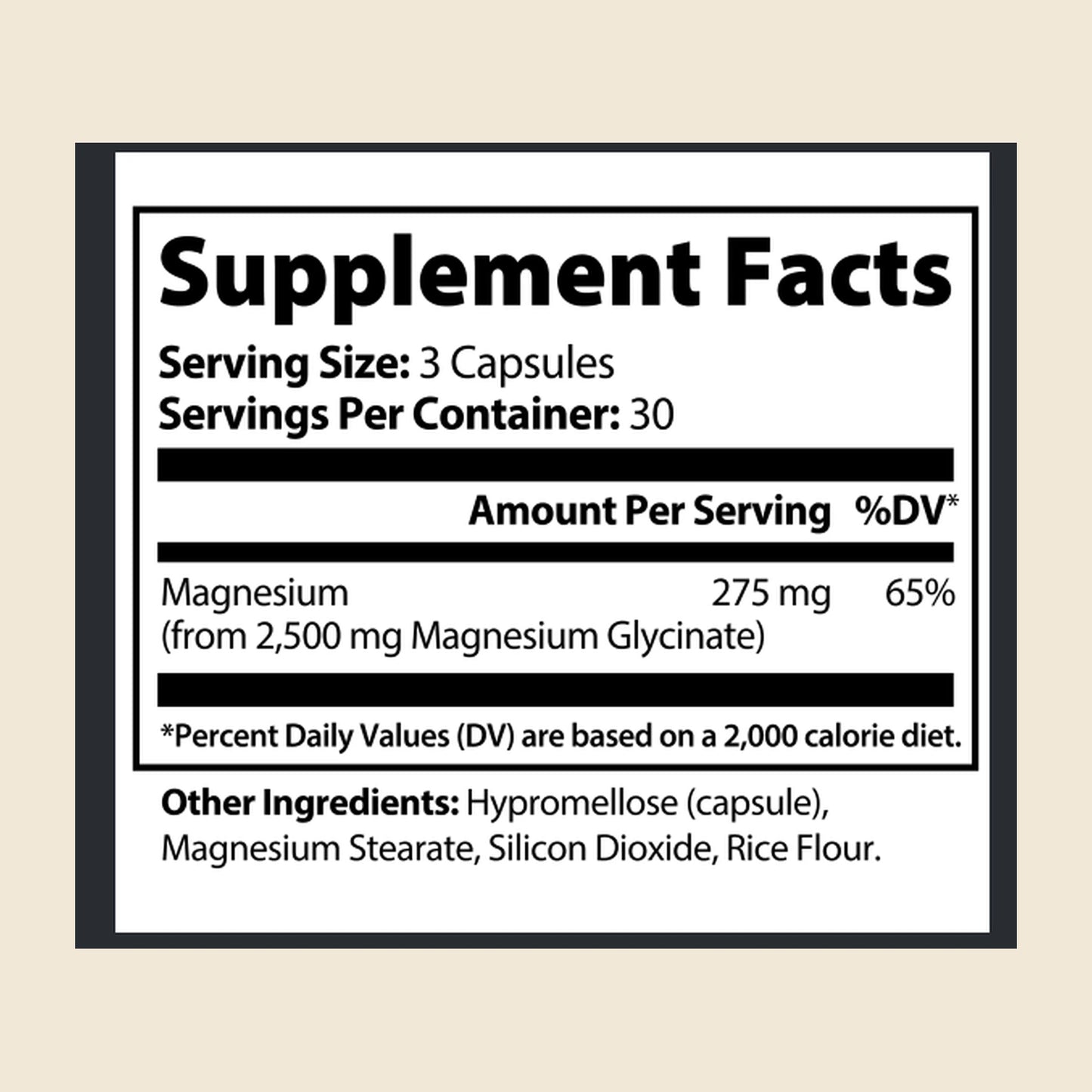
Magnesium (as magnesium glycinate) · 200 mg elemental. The form bonded to glycine — high bioavailability, gentle on the gut. Roughly 50% of the daily value for men. We dose it where the published trials dosed it.
Glycine · the carrier. Glycine isn't a passive shuttle. On its own, it's been shown to improve subjective sleep quality and reduce next-day fatigue in trials at 3 g. Inside this capsule it's lower-dose, but it pulls its weight by binding GABA-A and shifting your body toward parasympathetic rest.
Now what's not in it.
No magnesium oxide masquerading as magnesium glycinate (a common label trick — read the form, not just the headline). No magnesium stearate. No melatonin (we're not interested in nudging your hormones — glycine is gentler). No artificial colors. No artificial flavors. No proprietary blends.
Capsule is gelatin. Filler is brown rice flour. That's the list.
How to take it
Two capsules thirty to sixty minutes before bed.
Glycinate doesn't need food — take it on an empty stomach if you'd rather. Most men take it with the last sip of water before lights out.
If you tend toward looser stools, start with one capsule for the first week. Glycinate is the gentlest form on the market, but every body is different.
Take it nightly. Magnesium status builds over weeks, not per dose — skipping a night here and there won't undo your progress, but consistency is what closes the deficiency gap.
The 30-night promise
Take it for thirty nights. If you're not sleeping better when the bottle's empty, we don't keep your money.
Send back the bottle — empty is fine — and we refund every cent.
No phone call. No return form. No questionnaire.
The empty bottle is your receipt. We'd rather lose a sale than leave a man worse off than we found him.
Shipping & returns
Shipping. Free over $60 or with any 3 or 6-bottle bundle. Otherwise $4.95 flat — no surprise add-ons. Ships from our US warehouse within 24 hours. Most orders arrive in 3 to 5 business days.
Returns. 30-night money-back guarantee. Mail back any amount of the bottle — full, half-empty, completely empty. We refund every cent for the product. No restocking fees. No questions.
Subscription. Subscribe to any order at 15% off every refill. Single bottles refill every 30 days; bundles (3 or 6 bottles) refill every 90 days and include free shipping. Cancel anytime, any way: one click in your account, or one email.
Frequently asked questions
Why magnesium glycinate and not the cheaper kinds?
Two reasons.
It absorbs. Magnesium oxide — the form in most $5 drugstore bottles — is 4–15% bioavailable. Most of it passes through. Glycinate is 80–90%. If you're paying for a supplement that doesn't absorb, you're paying for an expensive way to do nothing.
It doesn't send you to the bathroom. Oxide is osmotic — it pulls water into the gut. That's what causes the loose stools and the urgency. Glycinate is the gentlest form on the market. People with sensitive stomachs use it daily without issue.
One more: glycinate absorbs without needing stomach acid. Most older adults have reduced gastric acid (and many are on a PPI on top of that). Oxide needs acid to dissolve. Glycinate doesn't.
Can I take it long-term?
Yes. Magnesium glycinate at this dose is well within the safe upper intake level (350 mg from supplements per day). Most older adults stay deficient unless they supplement, so daily use is the point.
If you have impaired kidney function, talk to your doctor first — your kidneys regulate magnesium and impaired kidneys can let it build up.
Will this interact with my medications?
Magnesium has fewer drug interactions than most supplements, but a few worth flagging:
- Antibiotics — magnesium can bind some antibiotics (tetracyclines, quinolones) and reduce absorption. Take them at least 2 hours apart.
- Bisphosphonates (Fosamax, Boniva) — same rule, 2 hours apart.
- Diuretics — most blood pressure diuretics deplete magnesium, so adding it back is usually helpful. Talk to your doctor if you're on a potassium-sparing diuretic specifically.
No significant interactions with most BP meds, statins, or sleep aids you might already take.
If you have kidney disease, talk to your doctor before adding any magnesium supplement — your kidneys are how you regulate it.
What about my kidneys?
Healthy kidneys regulate magnesium fine — your body excretes the excess. For most adults, this isn't a question.
If you have chronic kidney disease — particularly stage 3 or higher — talk to your doctor before adding any magnesium supplement. Impaired kidneys don't excrete magnesium well, and it can build up.
If you don't know your kidney function, your last annual blood draw probably showed it (look for eGFR on the lab sheet). Anything above 60 is the green zone.
How is this different from melatonin or Ambien?
Different mechanism, different goal.
Melatonin is a hormone — your body already makes it. Supplementing it nudges your circadian rhythm. It can work for jet lag or shift work, but most older adults still produce plenty of melatonin and don't need more. The biggest knock on melatonin: morning grogginess and unpredictable dose response.
Ambien is a prescription sedative. It works by binding GABA receptors hard. Real concerns past fifty: memory issues, fall risk, and dependence. Most prescribers won't write it long-term for that reason.
Walter's Magnesium PM works by closing a deficiency. The reason most older adults sleep poorly isn't that they need a sedative — it's that they're missing the magnesium their nervous system uses to wind down. Replace what's missing and the system tends to sort itself.
Glycine adds a gentle nudge on top — but glycine is an amino acid your body uses every day, not a hormone or a controlled drug.
Will it make me groggy in the morning?
No. That's the difference between magnesium and a sedative.
A sedative knocks you down. Your brain spends the morning recovering from the dose. That's the Ambien hangover.
Magnesium is replacement, not suppression. Your nervous system uses it to regulate, then your body excretes the excess. There's no morning hangover because there's no neurochemical hammer.
If anything, men report feeling clearer in the morning — because they actually slept. The fog of poor sleep is its own kind of grogginess.
Do I still need this if I eat well?
Probably yes — and the reason has nothing to do with how good your diet is.
The 4-out-of-5 deficiency stat is from NHANES, which includes adults eating salads and dark greens. The problem isn't intake. It's absorption. After fifty, your gut absorbs less of what you eat, your kidneys excrete more of what you've got, and common medications (PPIs, diuretics) deplete what's left. A magnesium-rich diet gets you to a baseline most older adults still can't hold without supplementation.
If your blood magnesium has been tested and it's mid-normal, congratulations — you're in the 20% who don't need this. Most men past sixty don't fall in that group.
Why a 30-night guarantee instead of 90?
Because magnesium status rebuilds faster than prostate tissue does.
For our prostate formula, the 90-night guarantee matches the actual ramp time — saw palmetto needs that long to do its work. Magnesium is faster: most men know within thirty nights whether their sleep is changing. So we set the guarantee to the real timeline.
What if it doesn't work for me?
Send back the bottle within 30 nights. Empty is fine.
We refund every cent. No phone call, no restocking fee, no questionnaire.
If Walter's Magnesium PM doesn't help, we don't keep your money.
How quickly will I notice it?
Most men feel something in the first three to five nights — a little easier to fall asleep, a little less awake at three.
The bigger shift is at weeks two to four, when your magnesium status actually rebuilds. Magnesium isn't a per-dose effect; it's a tank you've been running on empty. The 30-night guarantee exists because that's the window for the tank to refill.